
Project NTAS - Northwest Tropical Atlantic Station for air-sea flux measurement
| Sponsors | ||
| ||

| Related Links |
Research
The primary science objectives of the NTAS project are to determine the in-situ fluxes of heat, moisture and momentum, and then to use these in-situ fluxes to make a regional assessment of flux components from numerical weather prediction models and satellites.
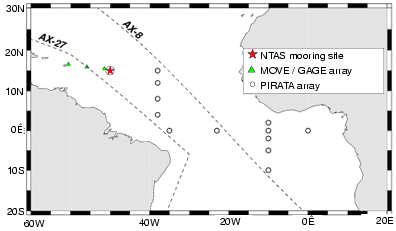
The scientific objectives will be addressed through analysis of observations from a surface mooring deployed near 15° N, 51°W. The NTAS site is at the eastern edge of the Guiana Abyssal Gyre/Meridional Overturning Variability (GAGE/MOVE) Experiment mooring array and can be considered a westward extension of the Pilot Research Moored Array in the Tropical Atlantic (PIRATA).
The NTAS Surface Mooring
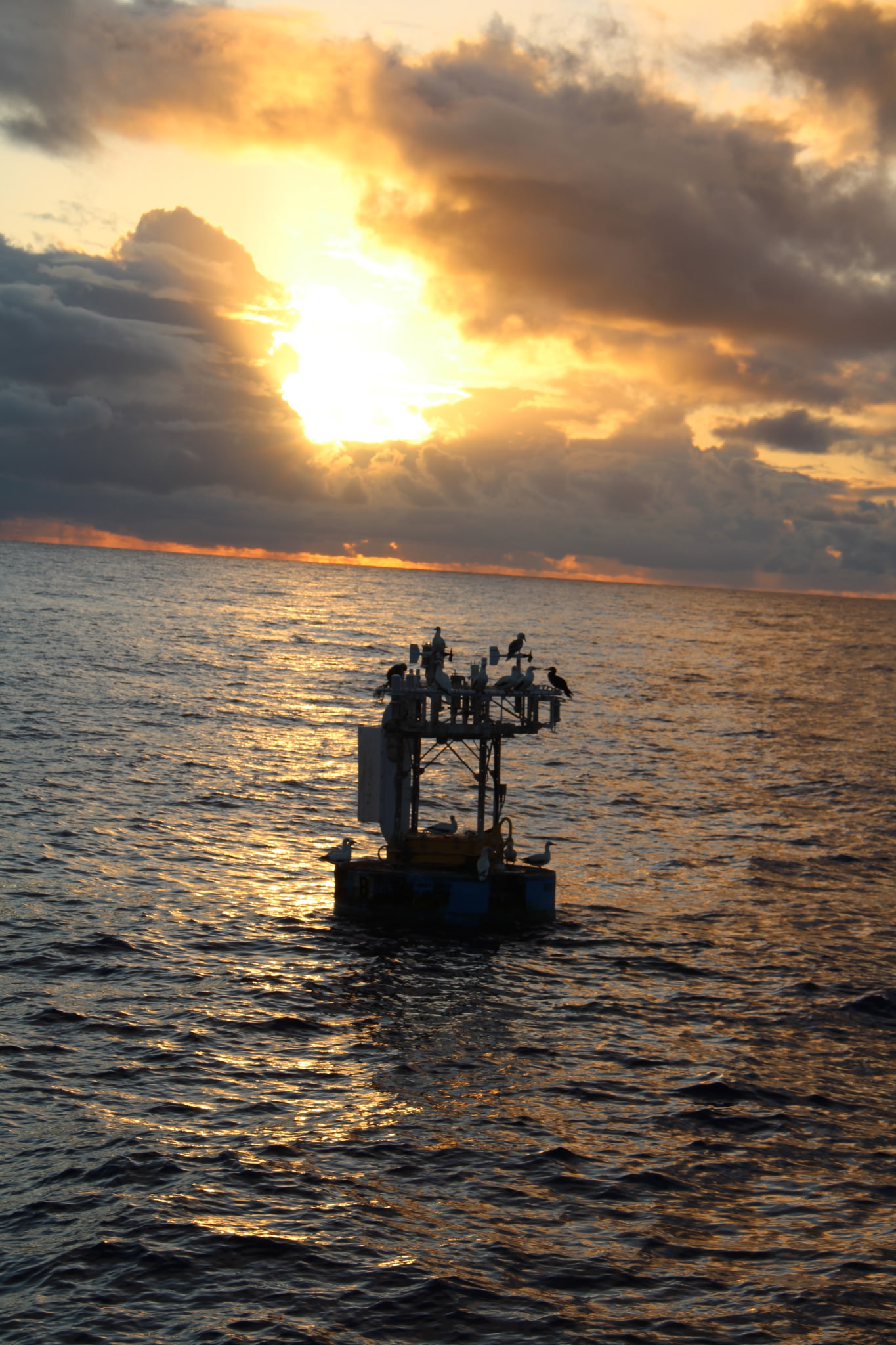
A surface mooring with sensors suitable for the determination of air-sea fluxes and upper ocean properties was deployed by the Upper Ocean Processes Group at 14 50' N, 51 00' W between 30 March, 2001 and 15 October, 2022. The three-meter discus buoy was outfitted with two complete sets of Air-Sea Interaction Meteorology (ASIMET) systems. Each system measured, recorded, and transmitted via Argos and/or Iridium satellite the surface meteorological variables necessary to compute air-sea fluxes of heat, moisture and momentum.
The NTAS site is WMO ID 48401, NDBC Partner Platform 41NT0.
A note on resolution, and one on ASIMet data formats.Real time data is sent back to shore by several subsystems on the buoy. The buoy is equipped with two ASIMet loggers that transmit hourly averaged met data using the Iridium network. A subsurface telemetry system, consisting of an inductive modem transmitting via Iridium, sends back data from several instruments on the mooring line. Links to near-real-time data are on the right-hand column of this page.
NTAS data is also available from the OceanSITES THREDDS server at NDBC.
The upper 120 m of the mooring line was outfitted with oceanographic sensors for the measurement of temperature and velocity. This was a long-term occupation of the site, with the mooring being refurbished at annual intervals.
Last updated: 2026/05/28